Augsburg to Frankfurt Airport: Swabia's route to the hub
Sit down with a map and Augsburg looks like it belongs to Munich Airport, not Frankfurt’s. It sits roughly 60 kilometres from Munich Franz Josef Strauß and around 360 from Frankfurt, on the far side of Bavaria and Baden-Württemberg. And yet the search term Frankfurt Airport transfer Augsburg gets typed hundreds of times a month, because the map only tells half the story. Route networks, not distance, decide where a lot of Augsburg’s travellers actually fly from — and once Frankfurt is the answer, the next question is how to get there without losing half a travel day to the journey itself.
Two airports, one decision
For most trips, Munich is the obvious default: a short run down the A8, a Lufthansa hub with its own intercontinental network, and more than enough capacity for European routes and a good slice of long-haul besides. Frankfurt enters the picture when one of three things is true: the destination isn’t served from Munich at all, or only via a connection through a third city; the fare is meaningfully cheaper routed through Frankfurt; or the airline of choice — a Star Alliance long-haul partner, or a non-Lufthansa carrier that concentrates its German operation on the Rhine-Main hub — simply doesn’t fly out of Munich. As Germany’s largest hub, Frankfurt carries a denser long-haul network than Munich, and travellers chasing a specific non-stop route or a specific arrival time end up there more often than the raw kilometre count would suggest.
Anyone weighing the broader question of when a long drive to a second hub actually pays off will find much the same logic, from the opposite direction, in our piece on the Munich to Frankfurt Airport route — the reasoning is nearly identical, just with a far shorter first leg for an Augsburg traveller.
ICE, the A8, or a driver
| Factor | ICE via Ulm/Stuttgart | Car on the A8 | Pre-booked transfer |
|---|---|---|---|
| Journey time | ~2h50–3h, some direct | ~3h35–40 without traffic | similar to driving, fixed schedule |
| Changes | none on some services | none | none |
| Luggage | you carry it, platform and terminal walks | in the boot, parking to find on arrival | door to door, driver helps load |
| Early or overnight departures | first trains often run too late | possible any time, but fatigue at the wheel | any time, fixed pickup |
| Cost structure | per-person rail fare | fuel plus airport parking | one fixed price for the whole group |
None of the three is the automatically correct choice. Augsburg sits closer to Frankfurt than Munich or Nuremberg do, but still well beyond the Rhine-Main commuter belt, so departure time and group size end up mattering more than the distance on its own.
By train via Ulm and Stuttgart
Augsburg Hauptbahnhof sits on the ICE corridor running through Ulm and Stuttgart toward Mannheim and Frankfurt — the same line long-distance services from Munich use to reach the Rhine-Main region. The fastest connections to Frankfurt Airport’s long-distance station run at roughly 2 hours 50 minutes, and most trains take just under three hours. Some departures run direct; others require a change in Mannheim or at Frankfurt Hauptbahnhof before the final leg to the airport station.
Travellers already planning to stop in Stuttgart, or checking a connection from there, can find more detail in our piece on the Stuttgart to Frankfurt Airport route. The long-distance station itself sits directly beneath Terminal 1; the free SkyLine people-mover reaches Terminal 3 in around eight minutes if that’s where the booked airline checks in.
The rail option’s usual weakness shows up at the edges of the day. No train out of Augsburg reaches the airport in time for an early-morning departure, since local services there only ramp up gradually and the first long-distance connections already need a substantial buffer before boarding. Anyone travelling with several suitcases should also budget real time for the walk between platforms, any change, and the terminal itself — not just the timetabled journey time.
By car on the A8
The road route runs from Augsburg onto the A8 toward Stuttgart, then the A7, then the A3 to the Frankfurter Kreuz interchange and onto the A5 into the airport. Route planners put the distance at around 360 kilometres and, without traffic, a driving time of three hours 35 to 40 minutes. That’s a long stretch to cover on the day of a flight, and the sections around Stuttgart and the Frankfurter Kreuz see regular stop-and-go traffic on weekdays, particularly in the late afternoon.
Driving yourself also means finding — and paying for — parking once you arrive, a chunk of time worth building into the schedule. For any trip longer than a few days, there’s a further cost beyond the parking fee: coming back from a long flight, tired, to locate your own car in an unfamiliar multi-storey car park. Over a distance this long, the car rarely turns out to be the most comfortable choice, even though it looks flexible on paper.
When a pre-booked transfer earns its keep
Over 360 kilometres, a pre-booked transfer pays off in three recurring situations. The first is a very early departure: Frankfurt Airport’s scheduled flight operations are largely paused overnight, with take-offs and landings restricted in the core window of roughly 11 p.m. to 5 a.m. A long-haul flight departing shortly after that window ends needs a journey that starts before Augsburg’s first train or any early local service is running. A driver with a fixed pickup time covers exactly that gap, independent of the rail timetable.
The second is a group or family travelling with heavy luggage. One vehicle moves several people and their bags in a single trip, without every traveller buying a separate rail ticket or a shared car having to fit four suitcases plus hand luggage in its boot. On a route where the train may involve a change, that difference matters more than it would on a short feeder run.
The third is a tight connection onto a long-haul flight. Travellers routing through Frankfurt onto an onward long-haul leg often have a limited window between arrival and boarding. A fixed pickup time, paired with ongoing flight tracking, removes the risk that a delayed train on the long approach eats into that window — the price is fixed and agreed in advance, regardless of how long the A8 actually takes on a given day.
Arriving at the new Terminal 3
Since it opened on 23 April 2026, Terminal 3 — spanning piers G, H and J — has taken on a growing share of Frankfurt’s flight traffic, while Terminal 2 no longer handles passengers at all; operations are now split between Terminal 1 and Terminal 3. For anyone travelling in, the practical takeaway is simple: double-check which terminal the booked airline actually uses shortly before departure if it isn’t obvious. With a pre-booked transfer, the driver typically handles that check directly and heads straight for the correct terminal, with the flight data tracked against the actual departure time.
Swabia on the move
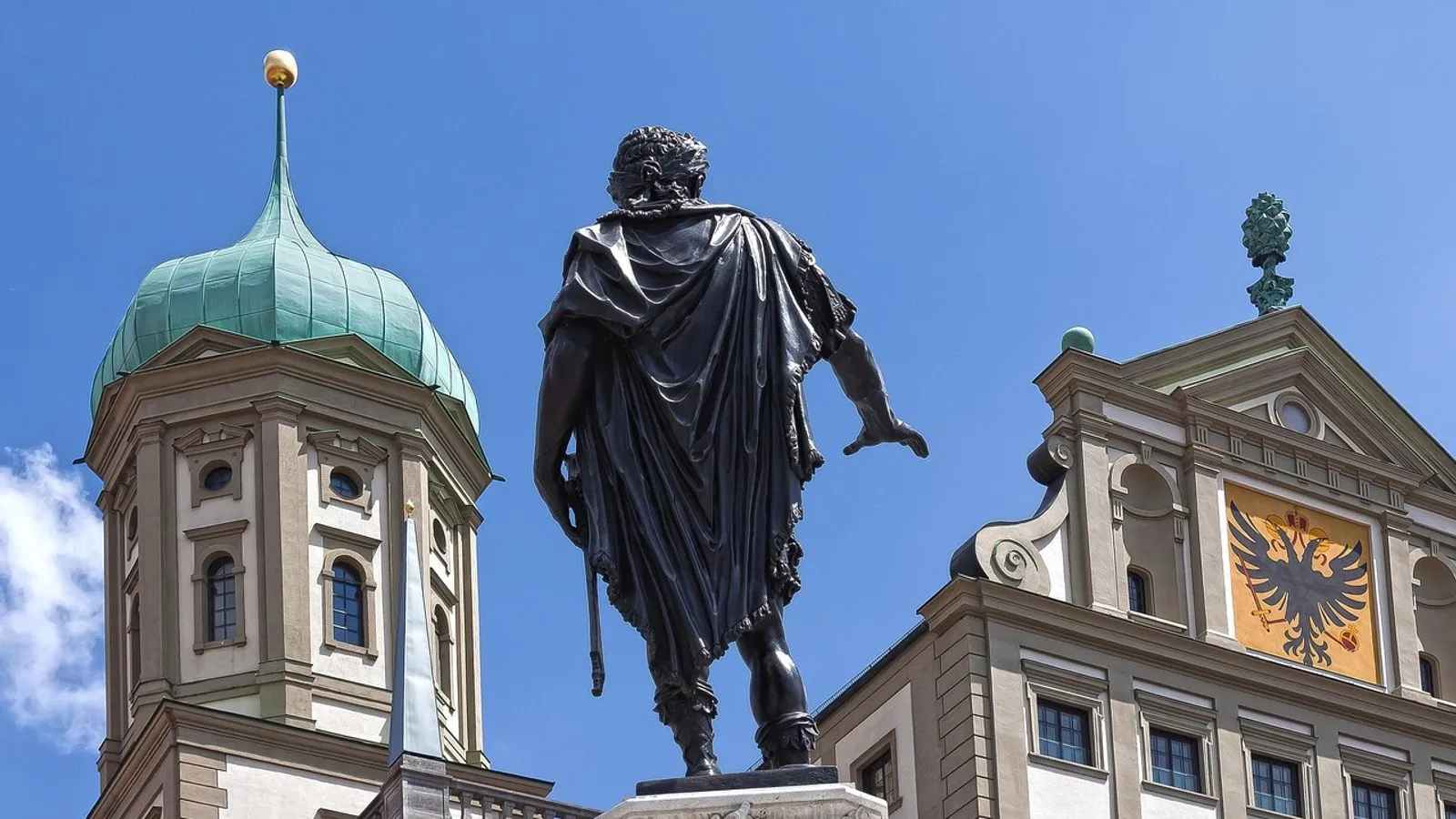
With roughly 307,000 residents, Augsburg is Bavaria’s third-largest city after Munich and Nuremberg — big enough to support a genuine business travel rhythm of its own. The “A” in the engineering firm MAN stands for Augsburg, where the company’s roots lie, and engineering along with aerospace suppliers still shape the local economy alongside the city’s older textile heritage. Business travellers here tend to move on fixed schedules with little slack for delay, which is exactly why the drive to the airport should be a known quantity rather than something left to A8 traffic on the day.
On the visitor side, Augsburg is best known for the Fuggerei, the oldest social housing settlement still inhabited anywhere in the world. Jakob Fugger had it built starting in 1523, and the token annual rent its residents pay has barely changed in five centuries — a detail that draws international visitors to look up Augsburg long before they think about the ride to their own return flight. Anyone planning that ride can work out a fixed price in advance: get a fixed price. The Augsburg to Frankfurt Airport route page lists journey times and vehicle classes for the specific run.
Frequently asked questions
Is Munich or Frankfurt Airport closer to Augsburg?
Munich Franz Josef Strauß is markedly closer, at around 60 kilometres, against roughly 360 kilometres to Frankfurt via the A8. Frankfurt’s larger hub network is still enough to pull a meaningful share of travellers past the closer airport for long-haul routes.
How long does the train from Augsburg to Frankfurt Airport take?
The fastest ICE connections via Ulm and Stuttgart reach Frankfurt Airport’s long-distance station in around 2 hours 50 minutes, with most trains taking just under three hours, sometimes with a change in Mannheim or at Frankfurt Hauptbahnhof.
Is driving the A8 a realistic alternative to the train?
Pure driving time via the A8, A7 and A3 runs around three hours 35 to 40 minutes, longer than the fastest train, before accounting for stop-and-go traffic around Stuttgart and the Frankfurter Kreuz or parking on arrival at the airport.
Does a pre-booked transfer make sense over such a long distance?
A pre-booked transfer mainly closes the gap for very early departures that no train from Augsburg can reach in time, and for groups with heavy luggage, for whom one vehicle beats several separate rail tickets — at a fixed price agreed before the drive, regardless of traffic on the A8.
Which terminal does a transfer from Augsburg arrive at?
Since Terminal 3 opened in April 2026, passenger operations are split between Terminal 1 and Terminal 3, while Terminal 2 no longer serves passengers; a pre-booked driver checks the correct terminal against the flight data in advance and drives straight there.