Central Hesse to Frankfurt Airport: Gießen, Wetzlar and Marburg
It’s shortly before six in the morning at Gießen Hauptbahnhof. The first regional train toward Frankfurt hasn’t left yet, and the second one would only just make the connection to the flight, assuming everything runs on time. Anyone living in central Hesse with an early departure from Frankfurt has run this exact calculation. A Frankfurt airport transfer from Wetzlar, Gießen or Marburg picked up at the actual front door removes that guesswork entirely, because the pickup time is set against the flight rather than the next available train. All three towns sit roughly an hour north of the airport by road, but they differ noticeably in how well they connect to it — and each one draws on a private transfer for a slightly different reason.
The region: three towns, one corridor
Gießen, Wetzlar and Marburg together form what the region simply calls “Mittelhessen” — a triangle of university towns and industrial sites strung along the river Lahn, linked by the A5 to the east and the A45 to the west. Gießen sits closest to the airport and most directly on the A5 corridor. Wetzlar lies roughly ten kilometres to the west on the A45, joining the A5 at the Gambacher Kreuz interchange. Marburg is furthest north, a good 30 kilometres beyond Gießen, and the drive time reflects that extra distance more than the other two towns combined. The structural point is the same for all three: there is no direct rail connection to the airport, and by road, time of day shapes the real journey time far more than the raw kilometre count does.
By car: the A5, the A45 and the Gambacher Kreuz
Drivers leaving Gießen take the A5 straight south — about 65 kilometres, roughly 40 minutes under normal conditions. From Wetzlar, the route runs first on the A45 to the Gambacher Kreuz, then onto the A5 for the remainder: around 68 to 70 kilometres, typically 48 to 54 minutes. From Marburg, the extra distance beyond Gießen stretches the trip to nearly 100 kilometres and, in practice, closer to 55 to 65 minutes depending on traffic on the A5.
The Gambacher Kreuz itself is the pinch point on this corridor. As the junction where the A5 meets the A45, in the triangle formed by Gießen, Wetzlar and Frankfurt, it funnels essentially all southbound traffic out of central Hesse — and it shows: as recently as July 2026, the ramp toward Kassel there was closed for construction for several weeks, with backups reaching onto both motorways. Anyone driving the route themselves should check current conditions before setting off; a transfer operator typically already knows about active closures at the dispatch stage and builds the buffer into the scheduled pickup time.
| Town | Drive time | Rail time | Main route |
|---|---|---|---|
| Gießen | ~40 min (~65 km) | ~66 min, with a change | A5 |
| Wetzlar | ~48–54 min (~70 km) | ~75 min, with a change | A45 → A5 via Gambacher Kreuz |
| Marburg | ~55–65 min (~95 km) | ~95 min, usually via Gießen | A5 |
By rail: the Mittelhessen-Express and the connection problem
Regional rail service out of central Hesse runs through the Rhein-Main Verkehrsverbund (RMV) on the Mittelhessen-Express, lines RB40/RB41 between Gießen and Frankfurt, calling at stops including Butzbach, Bad Nauheim and Friedberg, running hourly under the 2026 timetable with an extra service every two hours on top. What it doesn’t offer is a real through connection to the airport’s long-distance station: from Gießen, the fastest journey takes around 66 minutes with at least one change, across roughly 41 daily connections. From Wetzlar, a change pushes that closer to 73 to 76 minutes. From Marburg, the extra leg — usually routed via Gießen — stretches the trip to around 90 minutes, with about 44 connections a day.
For a traveller with heavy luggage, an early flight or several people travelling together, that means two changes with suitcases on a central Hesse platform — doable, but far from relaxed, especially since the first train of the day typically doesn’t leave until five or six in the morning, too late for a genuinely early departure. That gap between the last evening train and the first morning one is exactly where a private transfer, running independently of the RMV timetable, fills in.
Gießen and Marburg: two university towns with their own rhythm
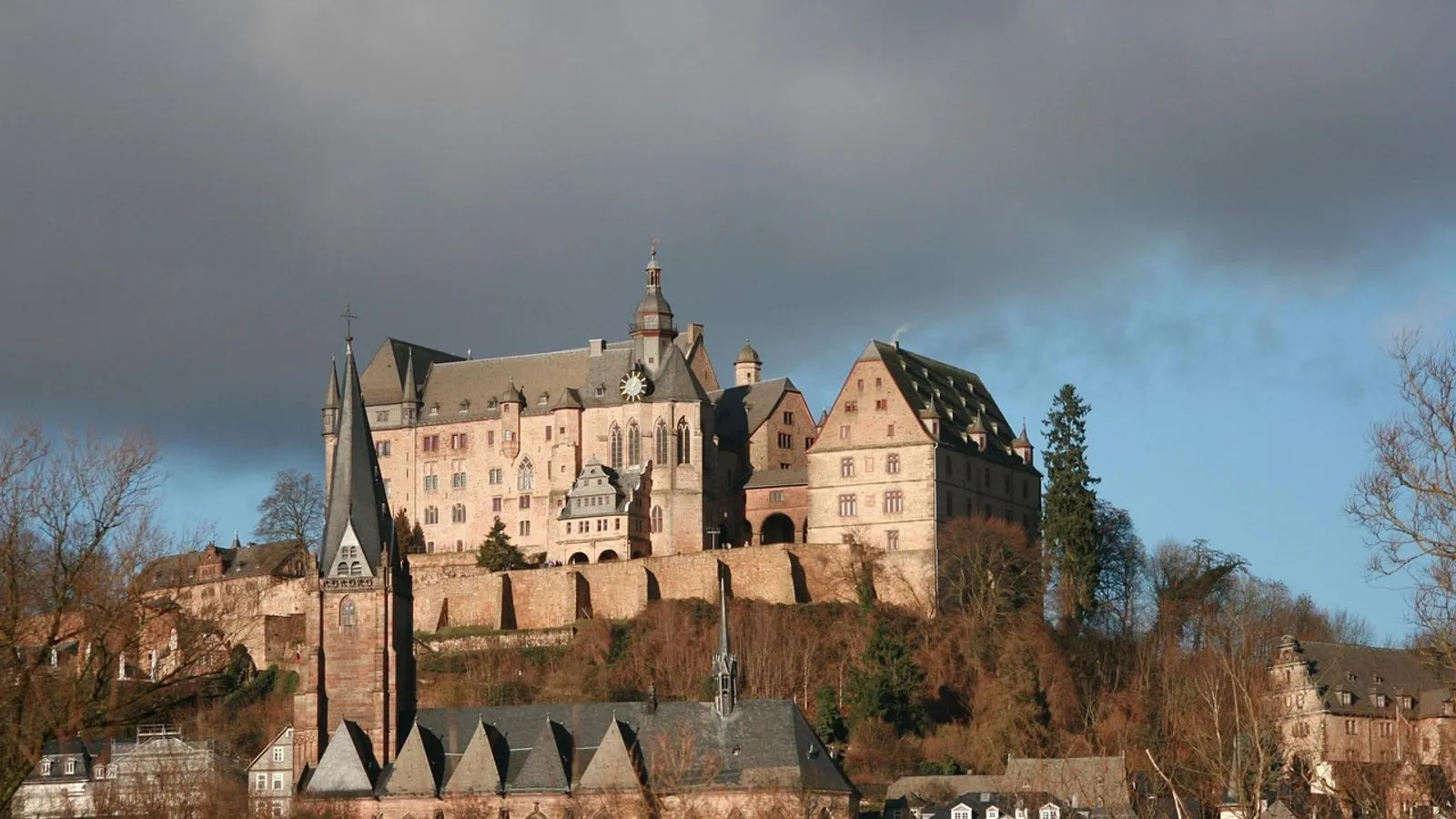
Both Gießen and Marburg are, above all, university towns, and that shapes their travel patterns significantly. Justus-Liebig-Universität Gießen regularly enrols well over 25,000 students across a broad range of subjects, from agricultural science to a veterinary medicine faculty that draws students and researchers from across the country, along with a correspondingly international crowd at conferences and research visits. Philipps-Universität Marburg, founded in 1527 as the world’s first Protestant-founded university, has again crossed the 20,000-student mark in recent counts and enrolled roughly 2,000 new first-year students for summer semester 2026.
For both towns, that produces a predictable seasonal rhythm: the start of term in October and April, exchange programmes, guest lectures and conferences all generate recurring waves of airport trips — often with little local knowledge on the traveller’s side and not much slack between landing and the first appointment. For an exchange student or visiting researcher arriving in central Hesse for the first time, a driver holding a name board at arrivals is a noticeably easier start than working out the right regional train in an unfamiliar language while dragging luggage.
Frankfurt airport transfer from Wetzlar: optics heritage and international guests
Wetzlar has its own, very specific travel pattern. The town has been one of the centres of the German optics industry for more than 160 years and remains the headquarters of Leica Camera — founded on this exact site in 1869 by Ernst Leitz, and still manufacturing there today. Around that heritage, a dense network of optics and photonics companies has grown up, one that regularly brings in international trade visitors, suppliers and clients. The W3+ Fair, Wetzlar’s trade show for optics, photonics and precision engineering, runs on a recurring cycle, with its next edition scheduled for March 2027, traditionally drawing exhibitors and trade visitors from across Germany and neighbouring countries.
For this group, reliability matters most: a flight landing in the late afternoon, a meeting the next morning at a Wetzlar factory or showroom, and a nearly 70-kilometre drive in between with zero local knowledge. A driver who already has the flight number and is waiting at arrivals removes far more uncertainty than an improvised regional train connection on an unfamiliar timetable.
When a pre-booked transfer earns its keep
Taken together, the driving times, the rail options and each town’s travel profile point to a fairly clear pattern. A single traveller with light luggage flying at a normal hour of day usually gets on fine with the Mittelhessen-Express. Once a very early or very late flight, several people with luggage, a conference running to a fixed schedule, or simply no familiarity with the RMV network enters the picture, the calculation shifts toward a fixed pickup time. The fixed price is set before the trip and holds regardless of a backup at the Gambacher Kreuz or a delayed flight. Anyone wanting to work out their own route from Gießen, Wetzlar or Marburg can check the fixed price for the trip in advance, noting pickup address, terminal and luggage at the same time.
Frequently asked questions
Is there a direct train from Gießen, Wetzlar or Marburg to Frankfurt Airport?
None of the three towns has a genuine through connection without a change. The fastest journey from Gießen runs around 66 minutes, from Wetzlar around 75 minutes, and from Marburg around 90 to 95 minutes, each requiring at least one interchange.
How long is the drive from Wetzlar to Frankfurt Airport?
Via the A45 to the Gambacher Kreuz and onward on the A5, the drive normally takes about 48 to 54 minutes over roughly 68 to 70 kilometres. Construction work or rush-hour traffic at the Gambacher Kreuz can add noticeably to that.
What is the Mittelhessen-Express, and does it run straight to the airport?
The Mittelhessen-Express (RB40/RB41) links Gießen to Frankfurt on an hourly schedule, calling at stops including Butzbach, Bad Nauheim and Friedberg. It does not terminate at the airport’s long-distance station, though, so reaching it still requires a change.
Why does Wetzlar draw so many international visitors travelling via Frankfurt Airport?
Wetzlar has been a centre of the German optics industry for more than 160 years and remains the headquarters of Leica Camera, founded there in 1869 by Ernst Leitz. The network of optics and photonics companies that grew up around that heritage brings a steady flow of international trade visitors and business travellers into the town, for whom Frankfurt Airport is the obvious arrival point.
Does a private transfer make sense for students or exchange visitors without a car?
It often does, particularly at the start of term or for short exchange stays, since pickup happens with a name board at arrivals and there’s no need to manage a change on the RMV network with luggage in tow. Booking itself only requires the flight number, terminal and destination address, regardless of local knowledge.