Luxembourg to Frankfurt Airport: the banking corridor

Luxembourg-Findel now serves more than a hundred destinations nonstop — a striking network for a country of roughly 660,000 people. And yet every week, fund managers, auditors and lawyers based in the Grand Duchy get in a car bound for Frankfurt, because the destination they actually need is not on Findel’s own timetable. A Luxembourg Frankfurt Airport transfer has become as routine for the region’s finance sector as the walk to the bank — not out of habit, but because Frankfurt carries the long-haul network Findel simply does not have.
The Luxembourg Frankfurt Airport transfer: why Frankfurt, not Findel
Luxair grew its 2026 summer programme to 101 destinations, adding new links to Helsinki, Edinburgh and Tunis among others — a real jump for a carrier of its size. Counting every airline based at the airport, Findel offers nonstop service to roughly 116 destinations across 32 countries. For European coverage, that is a genuinely strong network. The gap shows up on true long-haul routes: intercontinental service from Luxembourg runs mainly to Africa, the Middle East and China — the longest nonstop route flies to Zhengzhou and takes around ten and a half hours. There are no direct flights to North America or most of Asia; travellers heading there typically connect via Frankfurt, Paris, Amsterdam or London. For a finance sector whose clients and offices sit in New York, Singapore or Hong Kong, Frankfurt is simply the closer, deeper hub — not an exotic detour but the obvious starting point.
The route: via Wasserbillig and Trier
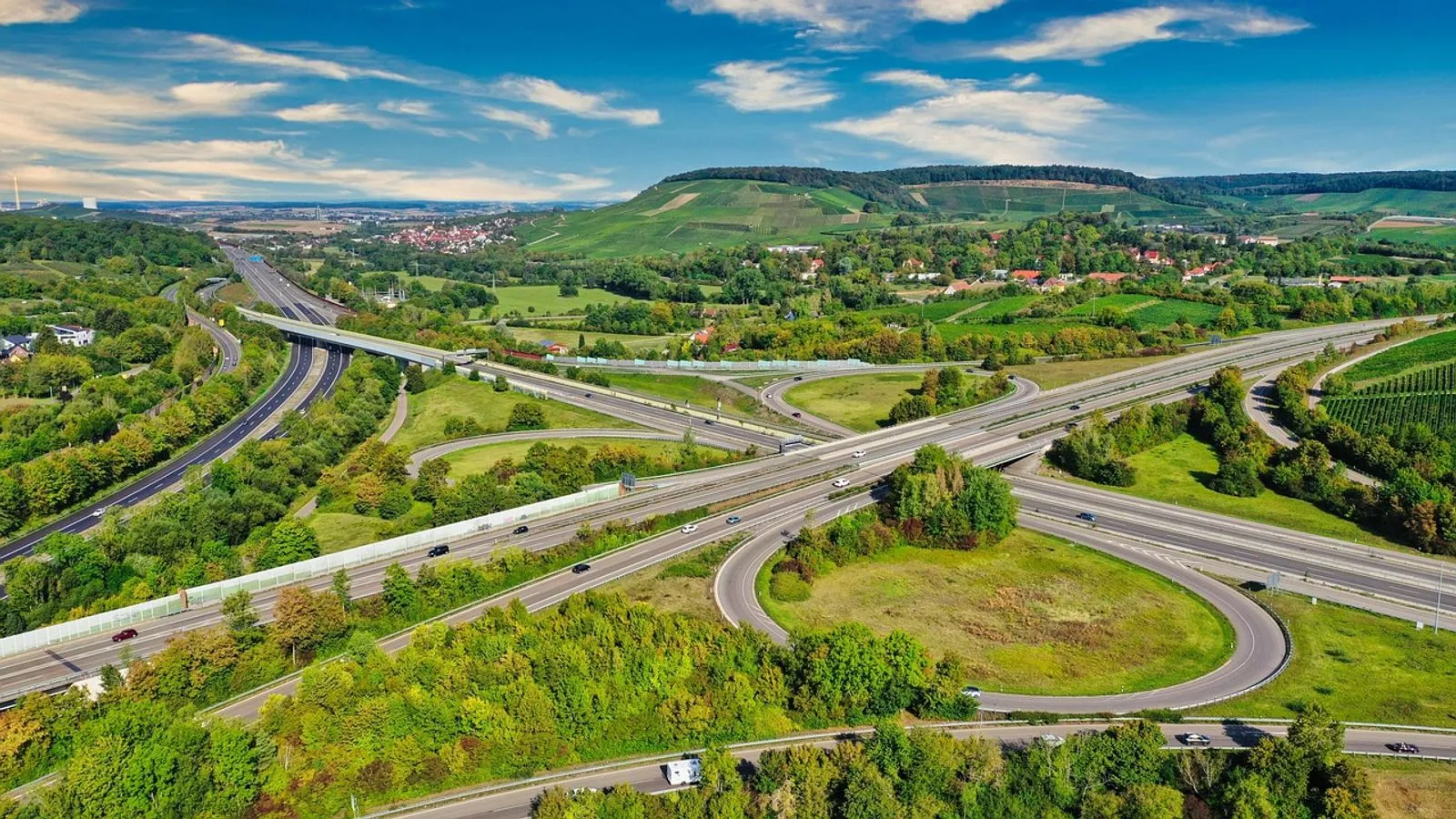
Drivers heading from Luxembourg City to Frankfurt take the A1 eastbound. At around 36 kilometres it is the shortest of Luxembourg’s three main motorways, and it ends at the German border in Wasserbillig, where it flows directly into the A64 toward Trier. From Trier, the route continues on the A1 and A48 toward Koblenz, then picks up the A61 before joining the A3 eastbound into Frankfurt. All told, that is roughly 233 kilometres, coverable in around two hours 49 minutes with clear roads. There is no border checkpoint along the way — both countries sit inside the Schengen area, so crossing at Wasserbillig is about as uneventful as crossing a state line. For travellers catching an early long-haul departure from Frankfurt, that means no queue at a border post and no uncertainty from passport checks — only the drive itself needs planning, plus a buffer for Rhine-Main traffic close to the airport.
The fund industry’s daily commute
Luxembourg is one of the largest fund domiciles in the world and the recognised European centre for cross-border fund administration. Law firms and audit practices with a Luxembourg presence routinely keep dedicated Frankfurt teams, because the two financial centres divide labour: fund structuring and domiciliation often run through Luxembourg, while capital-markets access and central-bank business run through Frankfurt. Geographic proximity — the two cities sit roughly two hours apart — makes same-day trips practical in a way that would not work between more distant financial centres. Someone with a morning meeting in Frankfurt’s banking district who needs to be back at a desk on the Kirchberg by afternoon is not thinking in flight schedules, but in door-to-door minutes — and for that specific problem, a booked car often beats a scheduled flight once airport dwell time on both ends is counted in.
Crossing without friction — but not without paperwork
Travel freedom is not the same as invoice freedom. Luxembourg has the lowest standard VAT rate in the EU at 17%, two points under Germany’s 19%. For a company booking a transfer for an employee or client, that is more than a footnote: cross-border B2B services generally fall under the reverse-charge mechanism set out in Article 44 of the EU VAT Directive — the supplier issues an invoice without VAT, noting that the recipient is liable for the tax, and the receiving company accounts for it in its own books. What matters most in practice is a correctly registered VAT identification number at the time of booking, particularly when a Luxembourg fund company or law firm settles the ride centrally. For how a fixed price is built in the first place, see our companion piece, fixed-price transfers explained.
Rail or road? An honest comparison
Anyone in a hurry should not overrate the train option: there is no direct service between Luxembourg and Frankfurt (Main) Hbf, so at least one change is required. Average journey time runs around four hours 42 minutes, with the fastest connections managing about three hours 41 minutes, spread across roughly 38 daily services in each direction. Driving — whether in your own car or a booked transfer — covers about 233 kilometres in close to two hours 49 minutes with clear roads, and remains the more predictable option, particularly for early departures where a missed connection is not an option.
| Mode | Distance | Journey time | Changes |
|---|---|---|---|
| Train | approx. 190 km | approx. 3h41m–4h42m | at least 1 |
| Car / transfer | approx. 233 km | approx. 2h49m (clear roads) | none |
The real difference is predictability: a booked transfer has a fixed pickup time from your door or office on the Kirchberg, tracks the return flight, and holds the standard 60-minute wait after landing — no connection risk and no dragging luggage across a platform change.
Booking the corridor for a company trip
For recurring travel — monthly board meetings, audit visits, closing weeks — a consistent booking routine pays off: flight number or appointment time, a pickup address in Luxembourg City or one of the surrounding communes, a preferred vehicle class and a reachable phone number are enough to confirm a ride. The same applies in reverse on the way back — landing time in Frankfurt, destination in Luxembourg, flight tracking and the waiting window included. Anyone using this A1/A64 corridor regularly for client or audit visits can calculate a fixed price in advance before the trip is even confirmed, which makes travel-expense planning considerably easier.
Frequently asked questions
Do you need identification to cross the border between Luxembourg and Frankfurt?
The Wasserbillig crossing sits entirely within the Schengen area, so no routine passport checks take place. A valid ID document should still be carried, since spot checks remain possible at any time.
Why do Luxembourg-based business travellers often fly out of Frankfurt instead of Findel?
Findel covers a dense European network, but genuine long-haul routes to North America or most of Asia are largely absent from its timetable. Frankfurt, as one of Europe’s largest hub airports, offers a far broader long-haul programme, which is what makes the short ground journey worthwhile for many travellers.
How long does the drive from Luxembourg City to Frankfurt Airport take?
Via the A1, the A64 at Trier, and onward via the A48, A61 and A3, the route covers around 233 kilometres, doable in roughly two hours 49 minutes with clear roads. Extra buffer is worth building in for Rhine-Main traffic closer to Frankfurt.
Does Luxembourg or German VAT apply to the transfer?
Cross-border B2B bookings generally fall under the reverse-charge mechanism: the invoice is issued without VAT, noting that the recipient is liable for the tax, and the receiving company declares the service in its own accounts. A valid VAT identification number at the time of booking is what keeps this correctly attributed.
Is the train a realistic alternative to driving?
There is no direct train between Luxembourg and Frankfurt (Main) Hbf; with at least one change, the journey averages around four hours 42 minutes, or about three hours 41 minutes on the fastest connections. For tight connections to early departures, the road remains the more dependable choice.