Frankfurt → Paris: crossing the border by transfer
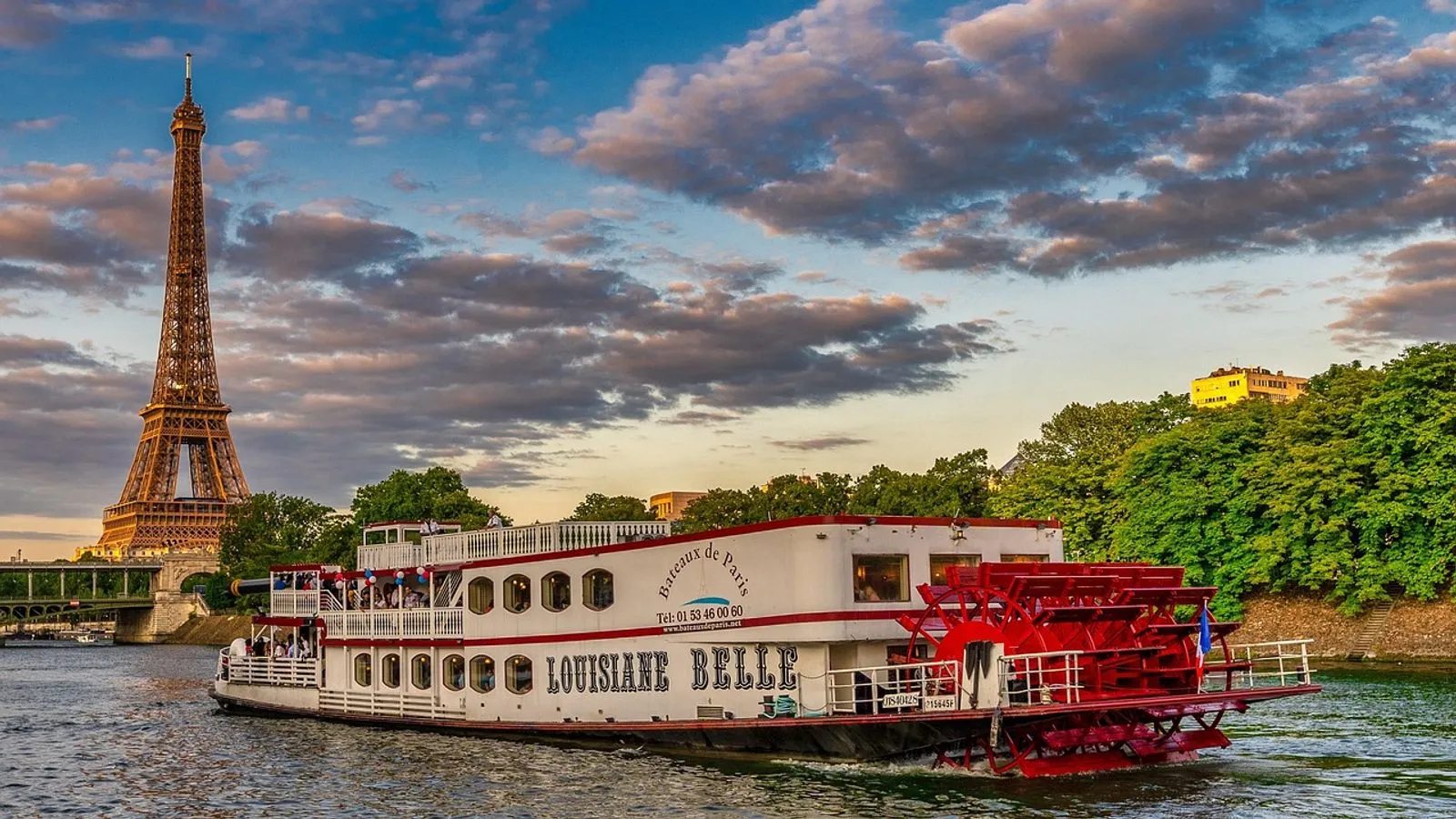
Paris sits 560 kilometres from Frankfurt Airport — a drive of roughly 5 hours 43 minutes. It is the longest single route we run regularly, which makes it a good test of when a cross-border transfer is actually worth taking.
The route
The corridor leaves the Rhine-Main area on the A 3 and A 67, then runs through Rhenish Hesse and the Palatinate on the A 60 and A 63 towards Saarland. After Saarbrücken it joins the French A 4 and follows it past Reims into greater Paris, with the final stretch coming in via Marne-la-Vallée.
Four points along the way are bookable destinations in their own right, each with its own page and its own drive-time facts:
| Intermediate destination | Distance from FRA | Drive time |
|---|---|---|
| Kaiserslautern | 106 km | ~75 min |
| Saarbrücken | 167 km | ~110 min |
| Metz | 235 km | ~151 min |
| Reims | 422 km | ~263 min |
| Paris | 560 km | ~343 min |
That matters practically: if you are heading to Reims or Metz, you book the same direction but a substantially shorter journey — and pay accordingly.
Border crossing & tolls
Germany and France are both in the Schengen area, so there is no fixed border control on this route. Carry your travel documents anyway: spot checks in the border region are permitted and do happen. Our piece on cross-border transfer basics covers the currently extended German border checks and the EES entry system in detail — the same rules apply on the run to Paris as on any other Franco-German land crossing. The actual crossing point here sits near Saarbrücken-Forbach, where the A 6 becomes the French A 4 — a different spot from the Rhine bridge at Kehl used by the Strasbourg route further south.
The practical difference is tolls. French motorways charge for use — the péage system bills by distance, paid at barriers during the journey. You do not need a vignette here, unlike in Austria or Switzerland. The tariff class depends on vehicle height: Class 1 covers ordinary cars up to two metres, Class 2 covers taller vehicles such as vans and large SUVs — a distinction that matters when choosing a vehicle for a group with a lot of luggage. Professional drivers rarely pay cash at the barrier; instead they use an electronic tag mounted on the windscreen (télépéage, such as Liber-t or Bip&Go) that opens the barrier automatically and settles the charge in the background.
For you as a passenger none of that changes anything: péage charges are part of the fixed price. The driver pays them en route and they never reappear as a supplement. This is precisely why a fixed price is worth more on a long route than on a short one — there are simply more line items that could otherwise land on you later.
Arriving in Paris: the low-emission zone and city traffic
Driving into central Paris has required an emissions sticker on top of the toll since 2025: the Crit’Air vignette. It is issued once, stays valid indefinitely for that vehicle, and is graded by emissions class. Since January 2025, only vehicles in classes 0 to 2 are permitted in the central Paris low-emission zone; the wider Grand Paris zone bans classes 3 to 5 and unclassified vehicles on weekdays between 8 am and 8 pm, though class 3 currently sits under a penalty-free grace period extended to the end of 2026. Driving without the sticker carries a fixed fine of 68 euros. None of that is something you need to manage as a passenger on a booked transfer — the vehicle carries the correct sticker already, and entering the city adds no extra stop.
In practice, the low-emission zone shows up mostly in the traffic itself. The Périphérique, Paris’s ring road, backs up reliably at peak times, and many destinations inside the city sit in 30 km/h zones with restricted through-traffic. A driver who knows the city can pick the right approach into a given arrondissement and divert onto side streets when needed — an advantage that matters more once you are inside an unfamiliar part of the city than it does on the motorway stretch before it.
Fixed price instead of changing trains
The honest comparison: for one person without much luggage, the TGV from Frankfurt to Paris is usually faster and cheaper than any road connection. There is no point arguing otherwise. In practice around seven direct trains run between Frankfurt Hbf and Paris each day, the fastest covering the route in about 3 hours 43 minutes; the average across all departures runs closer to just under 6 hours. Against that, the roughly 5 hours 43 minutes a transfer takes is not automatically the slower option — it just comes without a station change, a fixed timetable, or a connection to make at the far end.
The transfer earns its place in different situations:
- Arriving at FRA on a long-haul flight. Hauling cases to the long-distance station, changing, making a connection — for many people the continuous ride is the better trade even though it takes longer.
- Groups of three or more. The fixed price is for the vehicle. At three travellers the transfer often comes in under the sum of individual rail tickets.
- Destinations away from stations. A suburb in greater Paris is a changing-trains problem by rail and simply an address by transfer.
- Appointments that need slack. Your driver waits if the flight lands late; a booked TGV ticket does not.
- Luggage beyond the ordinary. Trade-fair equipment, instruments, sports gear — anything that becomes a problem on a train.
Larger groups are worth flagging early. Beyond four passengers with luggage, a bigger vehicle may be needed, and availability on a route this long depends more on lead time than it would for a short standard trip within the Rhine-Main area. Anyone travelling with more than four people or unusually bulky luggage is better off mentioning it at the enquiry stage rather than sorting it out on pickup day.
Practical notes
Over five to six hours of driving, plan for breaks — they are included in the fixed price and are not billed as waiting time. Where the distance requires it, dispatch arranges driver changes or rest-period compliance in advance; EU driving-time and rest rules for the driver apply on this route regardless of whether the distance covered falls in Germany or France, and are built into the schedule without affecting the fixed price.
Return journeys from Paris work the same way in reverse; you book the same route with the addresses swapped. It’s also worth checking the return flight time out of Frankfurt Airport: scheduled flights are generally barred from operating roughly between 11 pm and 5 am, so a pickup in Paris timed against an early departure is worth building in some slack for. And if your destination is not Paris itself but somewhere along the way, almost every place on this corridor has its own page here with real distance and drive time.
For a special route, several stops or a group, the contact form is the fastest path — long-distance journeys with intermediate stops are quoted by a person. For a standard one-way trip, the booking page is enough to work out a fixed price for the Frankfurt–Paris route in advance.
Frequently asked questions
How long does the drive from Frankfurt to Paris Airport take?
The road journey covers 560 kilometres in roughly 5 hours 43 minutes, via the A 3, A 67, A 60, A 63 and the French A 4. Travellers heading to Metz or Reims instead book the same direction but a considerably shorter drive, at around 151 and 263 minutes respectively.
Do I need a toll vignette for this route?
No toll sticker applies on the German side of this route at all, and the French A 4 instead bills through the distance-based péage system rather than a flat vignette like the ones required in Austria or Switzerland. On a booked transfer, the driver settles that charge automatically during the drive.
What applies when entering central Paris?
Since 2025, entering the central Paris low-emission zone requires a Crit’Air vignette in classes 0 to 2, and the wider Grand Paris zone bans older vehicle classes on weekdays during the day. On a booked transfer, the correct sticker is already fitted to the vehicle, so this adds no extra step for passengers.
Is the transfer worth it compared with the TGV?
For one traveller without much luggage, the TGV’s fastest journey time of around 3 hours 43 minutes usually makes it the cheaper and often quicker option. The transfer wins out for groups of three or more, for destinations away from the main stations, after a long-haul flight with substantial luggage, or when a delayed flight needs a wait that costs nothing extra.
Should I expect checks at the border near Saarbrücken?
This internal Schengen border carries no fixed border control, but Germany’s federal police do run spot checks, extended at all land borders until at least 15 September 2026. Travel documents are worth keeping accessible regardless; our cross-border transfer basics piece covers the detail.