Bischofsheim: one state line, two fare regimes
Bischofsheim carries its peculiarity in the name of its station: it is still called Mainz-Bischofsheim, even though the town has belonged to Hesse since 1945. That is not a curiosity for local historians. It has concrete consequences — including for anyone calling a taxi in Bischofsheim or planning a journey to Frankfurt Airport. The nearest large city lies in a different federal state, and therefore in a different fare regime.
A municipality in the Mainspitze
Bischofsheim has 13,034 residents (as of 31 December 2025) and sits in the Groß-Gerau district, in the middle of the Mainspitze — the triangle between the Main and the Rhine south of the Main’s confluence. To the north the Main separates it from Hochheim am Main; to the east lies Rüsselsheim am Main; to the south and west, Ginsheim-Gustavsburg.
That allegiance was not always so clear. On 1 January 1930 Bischofsheim was incorporated into Mainz and remained a Mainz district until 1945. Only the postwar occupation-zone boundaries returned it to Hesse and the Groß-Gerau district. The station name stayed — as did an everyday orientation that still points strongly west.
| Detail | Bischofsheim |
|---|---|
| District | Groß-Gerau |
| Population | 13,034 (as of 31 December 2025) |
| Distance to the airport | 20 km |
| Drive time to the terminal | approx. 18 minutes |
| Location | Mainspitze, between the Main and the Rhine |
| Rail | S8 and S9 from Mainz-Bischofsheim |
A town that grew out of its marshalling yard
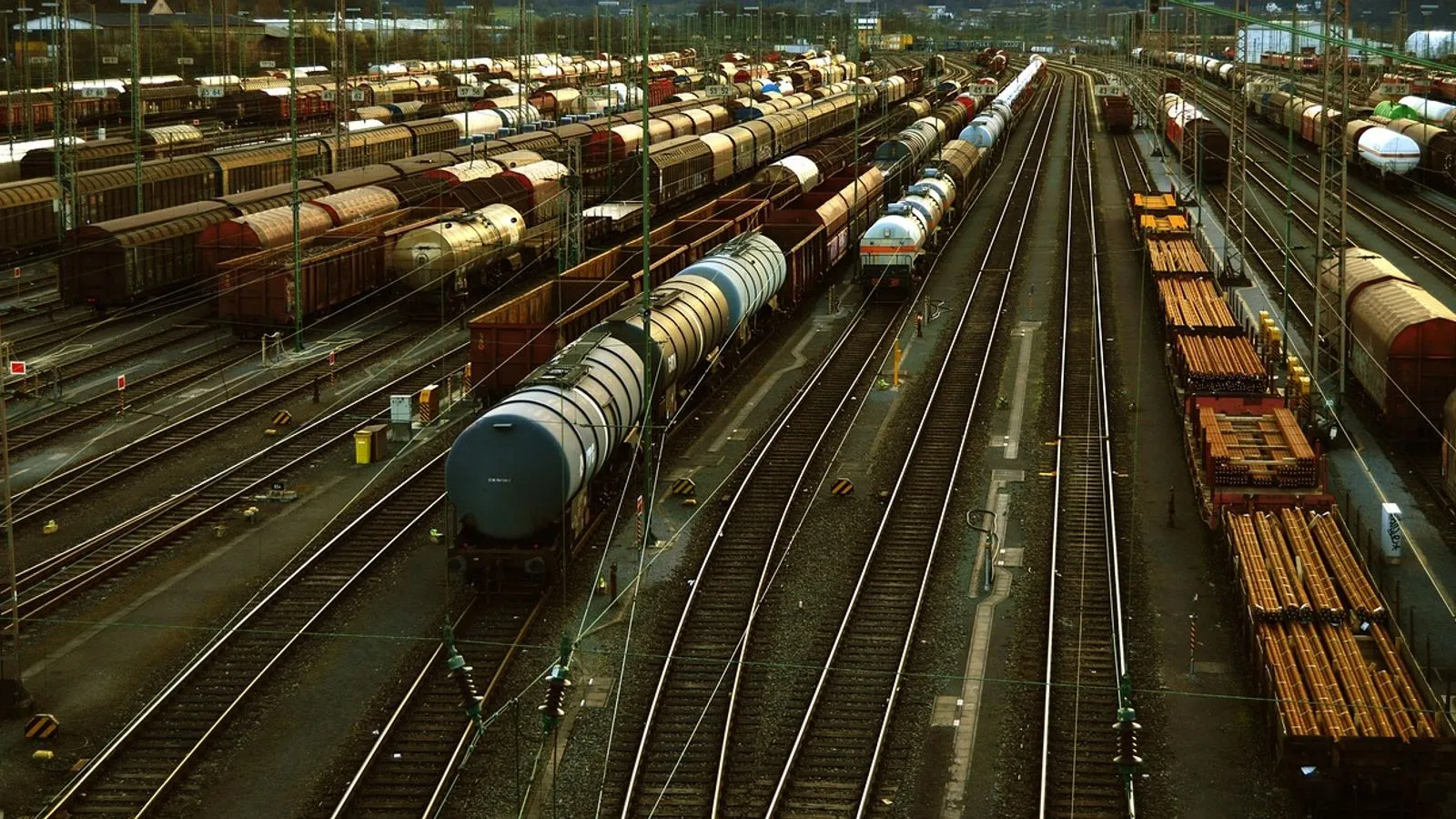
Bischofsheim is a railway town in the literal sense. Mainz-Bischofsheim station is an important junction with a marshalling yard, and that position still shapes the local economy: proximity to the Opel plant in Rüsselsheim and to Frankfurt Airport has drawn logistics companies above all.
By road, the A60 meets the A671 at the Mainspitz-Dreieck, and the B43 runs through the municipality. The airport is 20 kilometres away, about 18 minutes of driving — notably quick for the distance, because the route runs almost entirely on high-capacity roads rather than through town centres.
One building repays a look: the Catholic Christkönigskirche, designed in 1926 by Dominikus Böhm, was the first church in Germany dedicated to the Feast of Christ the King — a feast only instituted in 1925.
The state line you cannot see
This is the real difference from every neighbouring town further east. Bischofsheim belongs to the mandatory service area of Frankfurt’s taxis — and the city’s taxi tariff carries one sentence that weighs more heavily in the Mainspitze than anywhere else: the part of the region belonging to Rhineland-Palatinate is excluded.
Mainz is only a few kilometres away and yet, in tariff terms, another world. The neighbouring city’s large taxi fleet answers to a different licensing authority, and a journey across the state line does not follow the Frankfurt tariff. What looks like a suburb on the map is, in transport law, a small foreign country.
The practical consequence sits in the same rulebook. Where the official tariff applies, fares are fixed and cannot move in either direction. Beyond it, the tariff demands a price agreed before departure — and the meter may then be switched off even on the Hessian side. Driving west out of Bischofsheim means crossing, in the middle of your own neighbourhood, from a fixed pricing system into a negotiated one. The reasoning behind it is in our piece on fixed-fare taxis at Frankfurt Airport.
A pre-booked transfer does not know that boundary: the route is priced as a whole, regardless of which authority governs which stretch, and the price is settled before you book.
Train or car?
From Mainz-Bischofsheim station the S8 and S9 run — the same lines that serve the airport’s regional station. A regional service towards Darmstadt and Aschaffenburg adds to them. So for one person with light luggage, travelling in daylight and living near the station, the train is genuinely the obvious choice, and we would rather say so than leave it out.
The limitations are the same as everywhere on this corridor: before six in the morning and late at night the service no longer runs at that frequency; with two large cases the walk to the platform becomes work; and with several travellers the calculation flips, because a transfer’s price is for the vehicle rather than per person. Living further from the station also means a journey before the journey.
Who travels this route
- Logistics workers, whose hours follow handling schedules rather than a public-transport timetable.
- Commuters to the plant and the airport, for whom both are neighbours rather than destinations.
- Travellers on early flights, for whom the first S-Bahn arrives after check-in closes.
- Families and groups, where luggage and headcount decide the vehicle class — calculated in advance rather than improvised on a platform.
Before you book
In a logistics town, one entry is worth more than most: the exact access point. At haulage addresses and on works sites, the gate often sits several hundred metres from the street shown on the map — put the gate or unit number in the notes field and the pickup starts where you are actually standing.
For arrivals it is the flight number that counts: it is the reason a pickup follows the real landing rather than the timetable. Where the driver waits is described in our guide to pickup at Terminal 1 and Terminal 3; the route itself, with drive time and a fixed price, is on the Bischofsheim airport transfer page.
Frequently asked questions
Why is the station called Mainz-Bischofsheim if the town is in Hesse?
Bischofsheim was incorporated into Mainz on 1 January 1930 and remained a Mainz district until 1945; the postwar occupation-zone boundaries returned it to Hesse and the Groß-Gerau district. The station name stayed as it was.
Does the Frankfurt taxi tariff apply on a trip from Bischofsheim to Mainz?
Mainz is not governed by the same tariff: Rhineland-Palatinate transport territory is expressly excluded from Frankfurt’s mandatory area, even though the city is only a few kilometres away. For such journeys the tariff requires a price to be agreed before the trip begins.
How far is Bischofsheim from Frankfurt Airport?
The route is 20 kilometres with around 18 minutes of driving — comparatively quick for the distance, because it runs almost entirely on high-capacity roads such as the A60, A671 and B43 rather than through town centres.
Does the S-Bahn run from Bischofsheim to the airport?
The S8 and S9 operate from Mainz-Bischofsheim station and also serve the airport’s regional station. With light luggage and daytime travel that is a good option; at the edges of the day and with heavy luggage the advantage lies with a through journey from your own address.
What is special about the Christkönigskirche in Bischofsheim?
Designed in 1926 by Dominikus Böhm, the Catholic church was the first in Germany dedicated to the Feast of Christ the King — a feast that had only been instituted in 1925.